Guía · Audiovisual · Intermedio · Generación
La hoja de campaña: una foto de tu producto, seis piezas de campaña
De la foto fea del proveedor y una foto neutra de una persona salen las seis piezas que un negocio de ropa necesita para vender. El sistema: un bloque base con IDENTITY LOCK y PRODUCT LOCK que se pega siempre, y seis encuadres cortos.
¿Qué es esto y cómo lo uso?
Una guía paso a paso. Síguela de arriba hacia abajo desde tu celular; no descargas nada.
Objetivo
Convertir DOS fotos —la foto fea que te manda tu proveedor (la prenda en un maniquí, en una bodega) y una foto de cuerpo entero neutra de una persona— en las SEIS piezas que un negocio de ropa realmente necesita para vender: la ficha de producto, la de historia con espacio para el titular y el precio, el detalle de la tela, la de movimiento, la de espaldas y la de portada. Y hacerlo sosteniendo a la vez la identidad de la persona Y la identidad exacta de la prenda, con un solo bloque base que se pega siempre y seis encuadres cortos que se le suman al final.
Qué es la hoja de campaña
Un negocio de ropa no necesita "una foto bonita". Necesita seis piezas distintas, porque cada una hace un trabajo que las otras no pueden hacer: la del listado de la tienda, la que lleva titular y precio, la del detalle de la tela, la de movimiento, la de espaldas y la de portada. Con una sola foto no vendes: te falta justo la que el cliente pide antes de comprar.
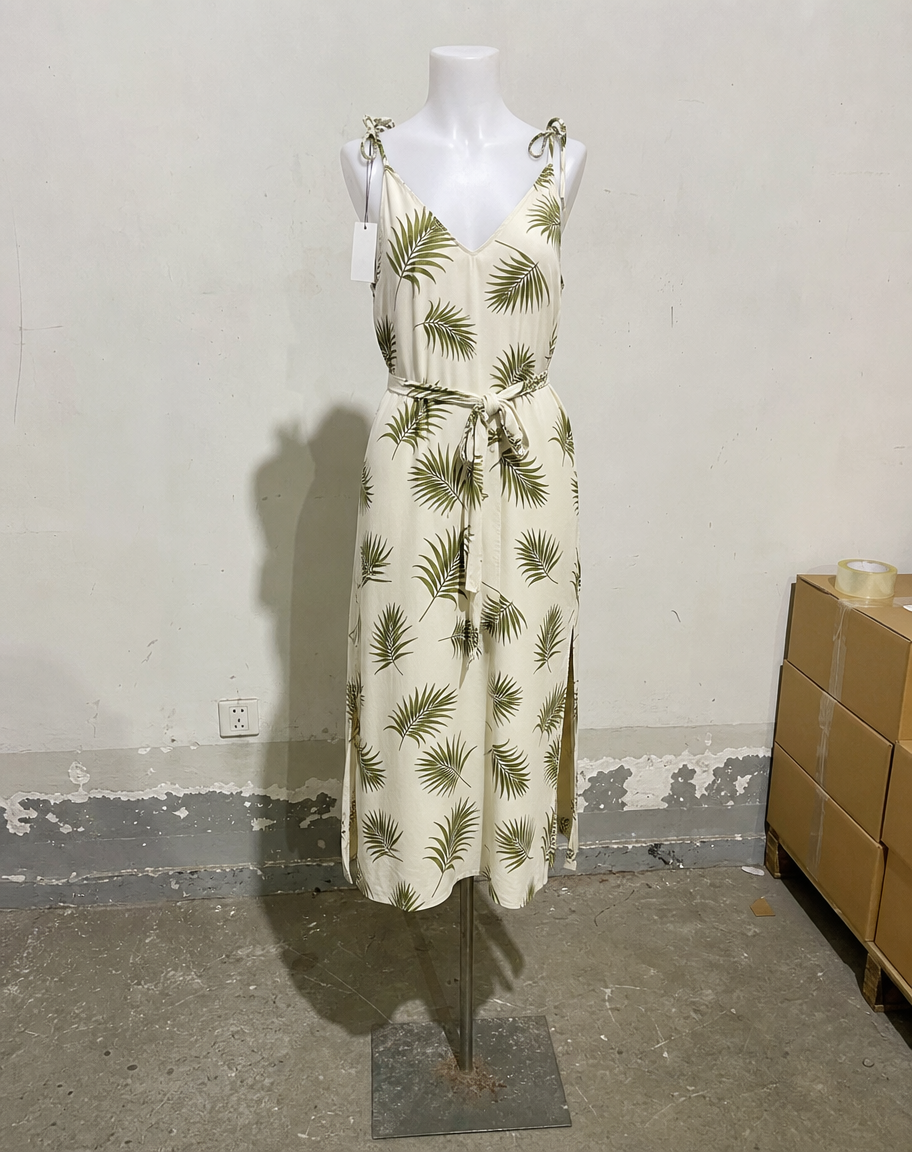
La hoja de campaña es sacar esas seis de dos fotos: la foto fea que te manda tu proveedor por WhatsApp —la prenda colgada en un maniquí de plástico, en una bodega, con luz de tubo fluorescente— y una foto de cuerpo entero neutra de una persona.
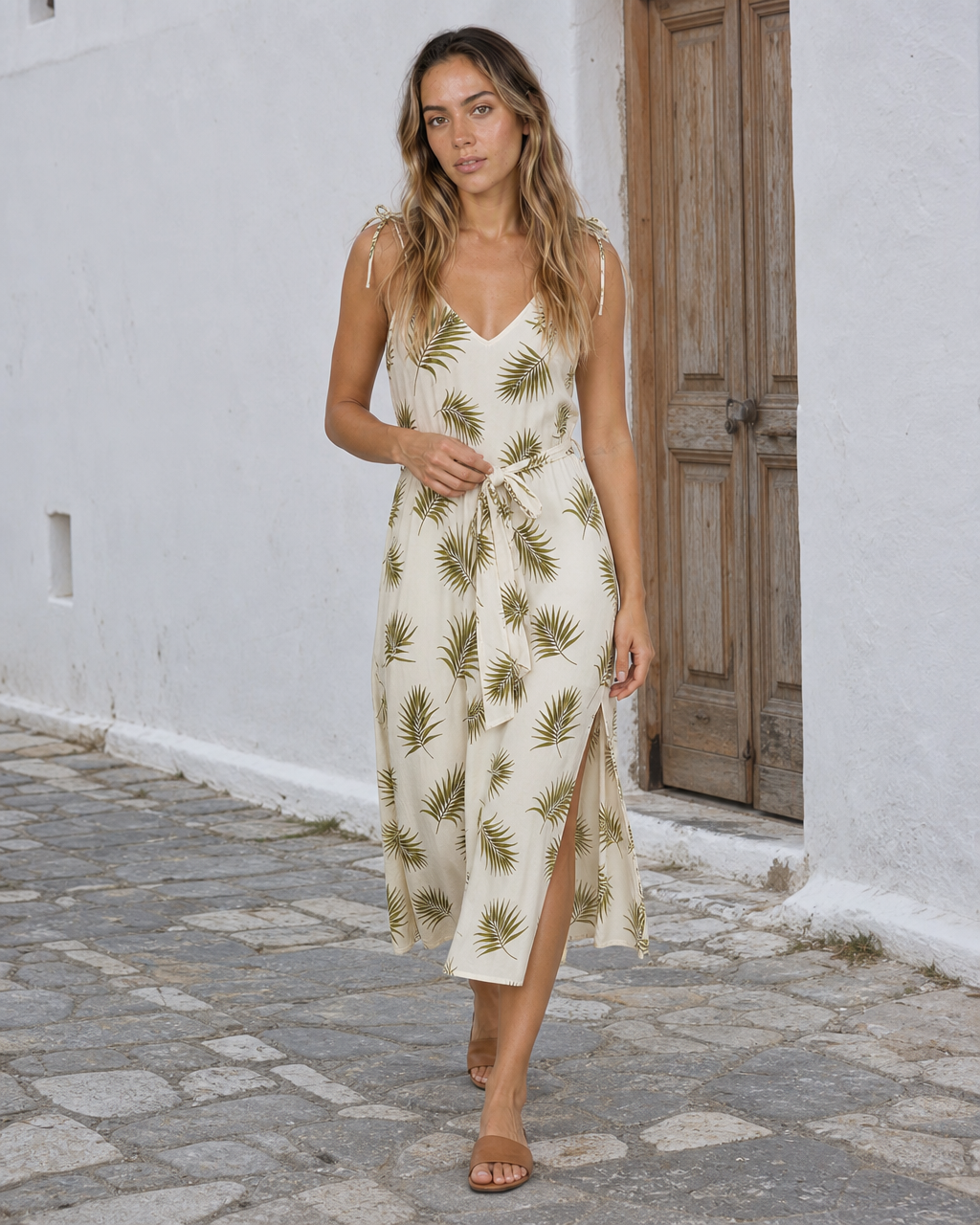
Abajo está el punto de partida real y una de las seis piezas que salieron de él. Míralas juntas: es exactamente la misma prenda, mismo estampado, mismos tirantes de moño, mismo largo, misma abertura.
El hallazgo: no basta con bloquear la cara
El IDENTITY LOCK —el bloque que impide que el modelo te cambie la cara— ya se conocía y ya funciona. Ese no es el problema.
Lo que tiene frenada a la gente es el segundo bloqueo, el PRODUCT LOCK: el que fija la prenda ancla por ancla. Sin él, la persona sí se sostiene entre tomas… pero la prenda no. Entre una foto y otra el escote cambia, el estampado se hace más denso, el largo sube y la tela pasa de mate a satinada. Y cuando la prenda cambia, ya no estás haciendo la campaña de tu producto: estás haciendo seis fotos de seis vestidos parecidos.
Por eso este sistema tiene un solo bloque base que se pega siempre —con los dos bloqueos dentro— y seis encuadres cortos que se le pegan al final. Nada más.
Lo que necesitas
Dos fotos, y cada una tiene su requisito:
- La foto del producto (IMAGE 2) — puede ser fea, de verdad. Maniquí, colgador, luz de bodega, encuadre torcido: da igual. Lo único que no puede fallar es que la prenda se vea completa y legible: el estampado, el cuello, el cierre o el nudo, el largo y cualquier detalle que la distinga. De esa foto nace la prenda; lo que no se vea ahí, el modelo se lo inventa.
- La foto de la persona (IMAGE 1) — de cuerpo entero, de frente, con buena luz y la cara despejada (sin lentes oscuros, sin gorra, sin pelo cruzando el rostro). Neutra: fondo liso, pose relajada. Mientras más neutra sea, mejor se le "pone" cualquier prenda encima sin que se pelee con la ropa que trae puesta.
1. El bloque base (se pega SIEMPRE)
Este bloque es el sistema. Va idéntico en las seis tomas, sin cambiar una coma, y después le pegas debajo el encuadre que quieras. Trae los tres bloqueos: la identidad de la persona, las anclas de la prenda y las reglas de realismo.
Ver el prompt completo ↓Plegar el prompt ↑
$ TWO REFERENCE IMAGES. IMAGE 1 IS THE PERSON. IMAGE 2 IS THE GARMENT.

=== IDENTITY LOCK (from IMAGE 1) ===
Preserve 100% of the woman's face shape, skull structure, hairline, long wavy sun-bleached blonde-brown hair, eyebrows, eyes, eye spacing, nose, lips, jawline, chin, cheekbones, tanned olive skin tone, skin texture, body proportions, height, build and age. She MUST be instantly recognizable as the exact same individual from IMAGE 1. DO NOT beautify, slim or reinterpret her face.

=== PRODUCT LOCK (from IMAGE 2) ===
She wears THE EXACT SAME DRESS from IMAGE 2, feature by feature:
1. Print: olive-green palm leaves on warm cream, leaves about 12 cm long, spaced apart with plenty of cream between them, NOT dense.
2. Thin shoulder straps tied in a small bow on top of each shoulder.
3. V-neckline.
4. Matching fabric belt in the same print knotted at the natural waist.
5. Midi length, hem at mid-calf.
6. Side slit on the right leg to just below the knee.
Lightweight viscose with soft drape. Do NOT redesign the dress, change the print scale, alter the neckline, shorten the hem or add sleeves. Discard the mannequin, price tag and warehouse from IMAGE 2 — only the garment carries over.

=== REALISM RULES ===
Real skin with visible pores and natural shine on forehead and nose, fine flyaway hairs, faint tan lines under the straps. NOT airbrushed, NOT smoothed. Fabric with real weight: soft folds falling from the belt knot, natural creases. NO creamy bokeh, backgrounds stay sharp and legible. NOT golden hour, NOT backlit orange. Photorealistic editorial fashion photography, fine film grain, Sony A7R V 50mm f/8 ISO 200.
No text, no logos, no watermarks, no brand names anywhere.Fíjate en el IDENTITY LOCK: describe a la persona con palabras aunque ya le estés subiendo la foto. No es redundante — es lo que impide que el modelo la "mejore". Y en el PRODUCT LOCK: seis anclas numeradas, ni una más. Más abajo está el criterio para elegir las tuyas.
2. Los seis encuadres
Cada uno se pega debajo del bloque base, tal cual. Lo único que cambia entre las seis piezas es esto.
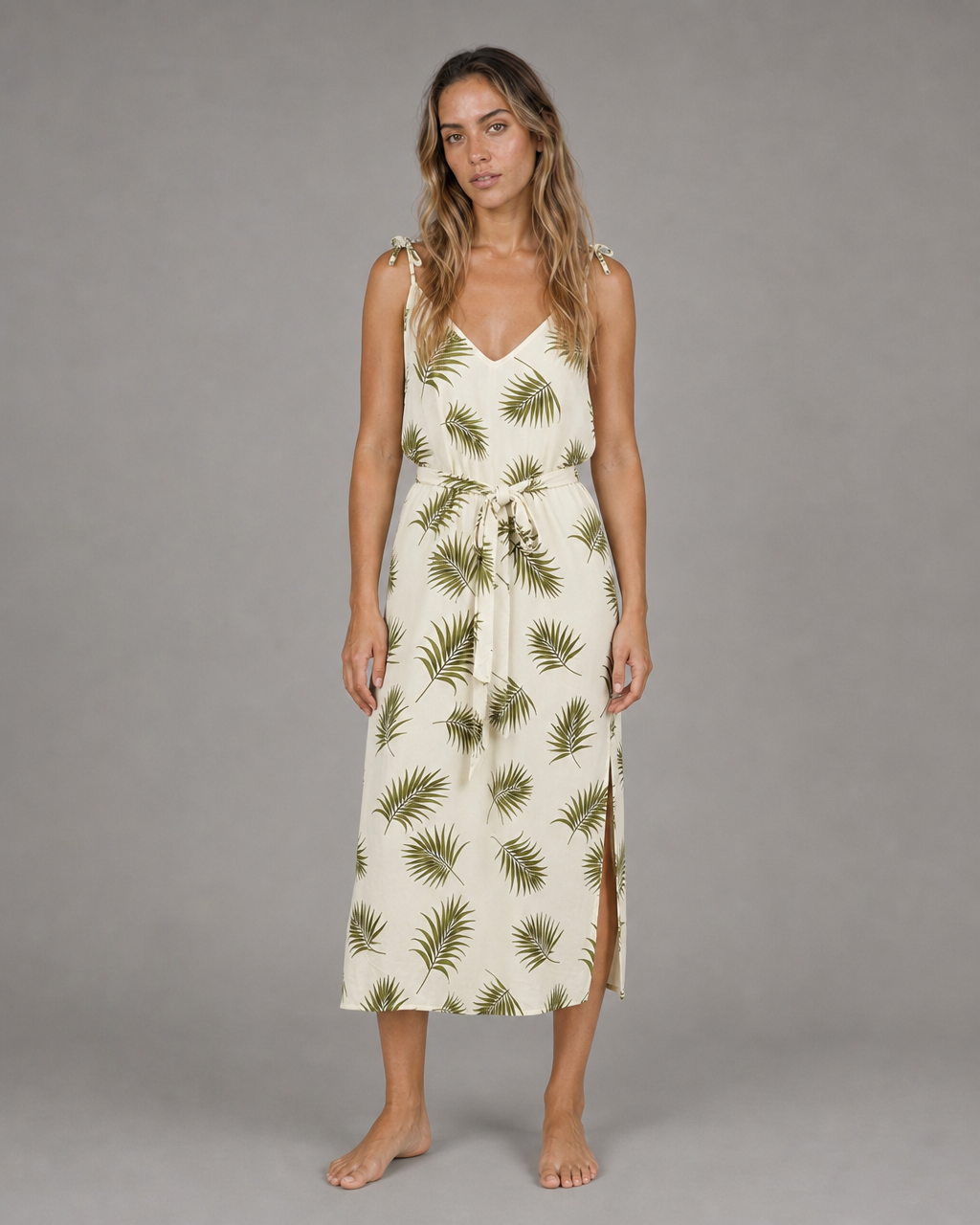
1. La ficha de producto
Para qué sirve: es la del listado de tu tienda online. Fondo neutro, cuerpo entero, sin ambiente que distraiga. La que decide si te dan clic.
Ver el prompt completo ↓Plegar el prompt ↑
$ === THE SHOT ===
E-COMMERCE PRODUCT SHOT for the online store listing. Vertical 4:5. Plain seamless light grey studio backdrop, no props, no scenery. She stands centred, facing camera straight on, feet slightly apart, arms relaxed at her sides so the whole dress is unobstructed and fully visible from the bow straps to the hem. Neutral catalogue expression, looking at the lens. FULL BODY visible, head to bare feet, with even space above the head and below the feet. Flat even studio lighting, soft shadow on the floor. The garment must be perfectly legible — this image exists to sell the dress, not the mood.2. La de historia
Para qué sirve: deja media lámina vacía a propósito. Ahí van después tu titular y tu precio, sin tapar la prenda. Es la de la historia de Instagram y la del anuncio con texto.
Ver el prompt completo ↓Plegar el prompt ↑
$ === THE SHOT ===
Campaign shot designed for a VERTICAL STORY with room for text. Vertical 4:5. She stands at the RIGHT THIRD of the frame, leaning her shoulder against a whitewashed lime wall, arms loosely crossed, looking off-camera to the left with a soft neutral expression. The ENTIRE LEFT HALF of the frame is empty flat whitewashed wall — clean negative space where a brand would later place a headline and a price. Three quarter body, cropped mid-shin. Bright overcast midday daylight, even and soft.3. El detalle de la tela
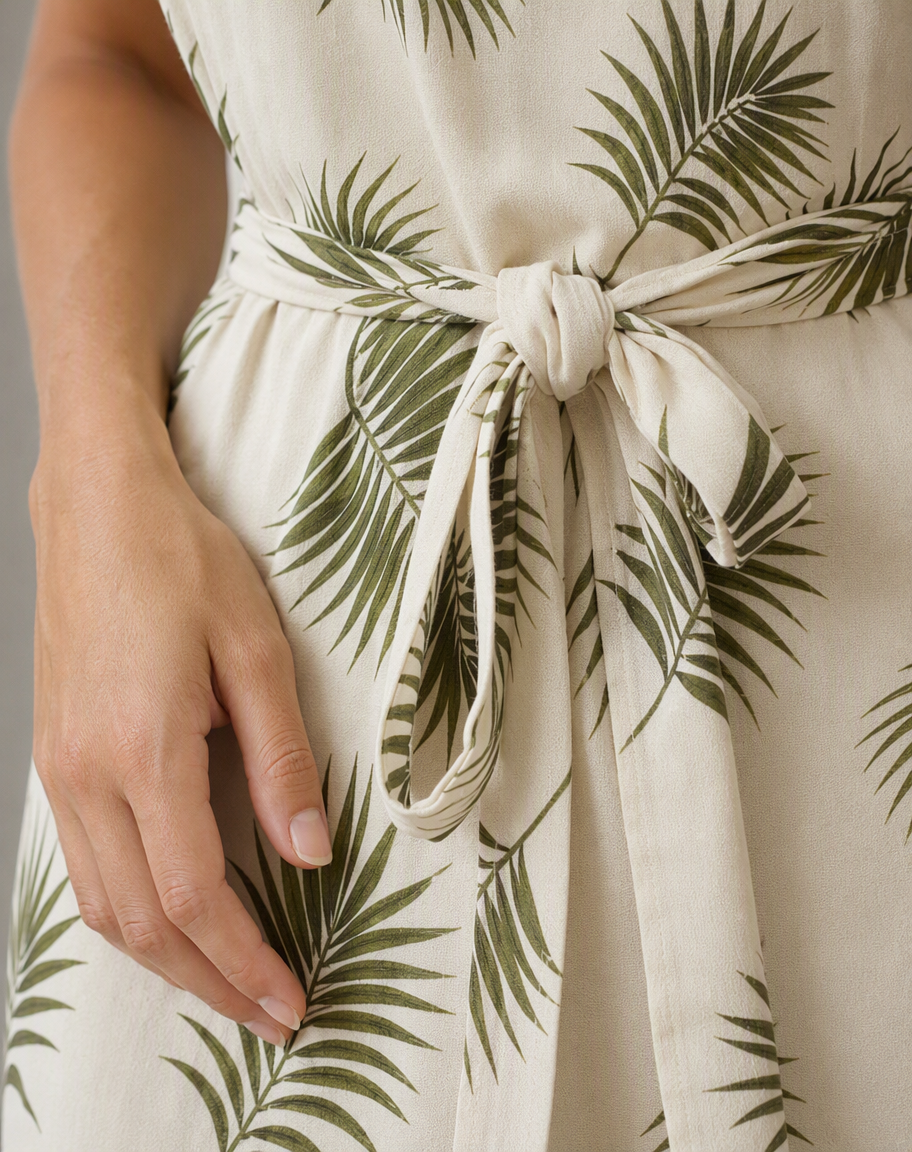
Para qué sirve: responde la pregunta que siempre llega por mensaje: "¿qué calidad tiene?". Es el macro que enseña el tejido hilo por hilo. Sin cara en cuadro.
Ver el prompt completo ↓Plegar el prompt ↑
$ === THE SHOT ===
EXTREME CLOSE-UP DETAIL SHOT of the fabric, for the product page. Vertical 4:5. Tight macro framing of her waist and hip area only — NO FACE IN FRAME, the crop starts below the chest and ends at the upper thigh. The knotted fabric belt fills the centre of the composition, with the palm-leaf print in sharp focus around it, the woven texture of the viscose visible thread by thread, the loose end of the belt falling. Her hand rests lightly beside the knot, fingers relaxed, showing scale. Natural daylight from a window at the left, gentle falloff to the right. Every fibre crisp — this shot exists to prove the fabric quality.4. La de movimiento
Para qué sirve: muestra cómo cae y cómo vuela la tela. Es la que convence de que la prenda se ve bien puesta y no solo colgada. Ojo con esta: es donde más se desvía el modelo (lee "Lo que hay que cuidar" abajo).
Ver el prompt completo ↓Plegar el prompt ↑
$ === THE SHOT ===
MOVEMENT SHOT, the one that shows how the fabric behaves. Vertical 4:5. She spins mid-turn on a sunlit cobbled terrace, caught at the instant the midi skirt lifts and flares outward to her left, the hem sweeping, the fabric belt ends flying, her hair mid-swing across her face, one hand raised near her shoulder. Genuine motion: a slight motion blur ONLY in the flying hem and the hair tips, while her face and torso stay sharp. Laughing, eyes half closed, unposed. Full body. She wears the SAME flat tan leather sandals as the rest of the campaign — NOT sneakers, NOT white trainers.

CRITICAL FABRIC NOTE: the dress is MATTE lightweight viscose exactly as in IMAGE 2 — a dry, soft, slightly textured weave that absorbs light. It is NOT satin, NOT silk, NOT shiny, NOT glossy. There must be NO specular sheen or highlight bloom on the fabric even while it is in motion. The print keeps the SAME leaf scale and the SAME wide spacing as IMAGE 2 across the flying hem — do not enlarge, stretch or scatter the leaves.

Bright overcast daylight.5. La de espaldas
Para qué sirve: la que toda tienda olvida y toda clienta pregunta. Cómo se ve por atrás, cómo cae desde los hombros, cómo se amarra. Contesta sola una decena de mensajes.
Ver el prompt completo ↓Plegar el prompt ↑
$ === THE SHOT ===
BACK VIEW, the shot every clothing store forgets and every customer asks for. Vertical 4:5. She stands with her back to the camera on a quiet street of whitewashed walls, looking over her right shoulder toward the lens with a calm half-smile, her hair swept to one side to reveal the back of the dress. The BOW OF THE RIGHT SHOULDER STRAP is clearly visible and in focus, along with how the back of the dress falls from the shoulders and how the belt ties at the waist. Three quarter body, cropped below the knee. Bright overcast daylight.6. La de portada
Para qué sirve: la del feed y la del anuncio. Es la que da la cara por la marca: la persona caminando, la prenda en movimiento suave, todo el cuerpo en cuadro.
Ver el prompt completo ↓Plegar el prompt ↑
$ === THE SHOT: campaign hero, for the brand's main feed post ===
Full-body fashion campaign photograph, vertical 4:5. She walks slowly toward camera on a narrow Mediterranean street with whitewashed lime walls and a weathered wooden door behind her, one hand lightly holding the fabric belt, the other relaxed, mid-stride so the skirt swings slightly to her left and the right side slit opens to show the knee. Confident, calm expression, looking just past the lens, chin level. Full body visible head to sandals — flat tan leather sandals.

LIGHT: bright overcast midday daylight, soft and even, neutral white balance, gentle shadows under the chin and the hem. NOT golden hour, NOT backlit, NOT warm orange, no lens flare, no sunset.3. Cómo adaptarlo a tu prenda
El bloque base no se reescribe. Solo cambias dos cosas:
- El IDENTITY LOCK, describiendo a tu persona (pelo, tono de piel, complexión, edad).
- Las seis anclas del PRODUCT LOCK, cambiándolas por las de tu prenda.
Estas son las seis del ejemplo, para que veas el nivel de detalle que hay que darles:
- El estampado — hojas de palma verde oliva sobre fondo crema cálido, hojas de ~12 cm, separadas entre sí, con crema visible entre ellas (no un estampado denso).
- Los tirantes — finos, anudados en moño encima de cada hombro.
- El escote — en V.
- El cinturón — de tela del mismo estampado, anudado en la cintura natural.
- El largo — midi, a media pantorrilla.
- La abertura — lateral, hasta justo debajo de la rodilla.
Más el tejido: viscosa ligera con caída suave.
El criterio para elegir las tuyas
- Pocas. Seis fueron suficientes. Cada ancla extra multiplica el riesgo de deriva: el modelo reparte su atención y termina soltando alguna. Si tienes doce candidatas, no las pongas todas — quédate con las seis que más definen la prenda.
- Concretas y medibles, no adjetivos. "Hojas de ~12 cm separadas entre sí, con fondo crema visible entre ellas" es una ancla. "Estampado tropical bonito" no es nada: el modelo lo interpreta distinto en cada toma.
- Las que si cambian se nota. Pregúntate qué haría que una clienta dijera "esta no es la misma prenda". Casi siempre: escala del estampado, escote, largo, cierre o amarre, y el acabado de la tela (mate o brillante). Esas van.
- Numeradas y verbatim. Van como lista numerada y se copian idénticas en las seis tomas. No las parafrasees entre una y otra: ahí es donde empieza la deriva.
Si tu prenda es una camisa, tus seis anclas serán otras (cuello, botones, puño, largo, tela, corte) — pero el formato es el mismo: número, nombre del detalle, descripción verificable.
Lo que hay que cuidar
- Sin PRODUCT LOCK, la prenda deriva aunque la cara aguante. Es el hallazgo central. El IDENTITY LOCK sostiene a la persona; la prenda necesita su propio bloque. Si te saltas el PRODUCT LOCK "porque ya subiste la foto del producto", entre toma y toma el escote cambia, el estampado se hace más denso, el largo sube y la tela se pone satinada.
- Pocas anclas, muy concretas. Seis, medibles, verbatim en las seis tomas. Es contraintuitivo: mientras más detalles le pides, peor se sostiene el conjunto.
- No pelees con la lateralidad, pelea con la constancia. Medido en este caso: el prompt pide la abertura en la "pierna derecha" y el modelo la resuelve siempre del mismo lado de pantalla, no de anatomía. Como no cambia entre tomas, la ilusión no se rompe y nadie lo nota. La lección es esa: lo que importa no es que el detalle esté en el lado anatómicamente correcto, sino que no varíe entre tomas. Si tu prenda sale espejeada pero consistente, déjala.
- En las tomas de acción, re-declara el material y los accesorios. La toma de
movimiento salió a la primera con la tela satinada y con tenis en vez de las
sandalias del resto de la campaña. Se arregló pidiéndolo explícitamente:
MATTE viscose, NOT satin, NOT shiny, no specular sheeny repitiendo el calzado. Es donde más deriva el modelo, porque la física del movimiento le "gana" a la descripción del material. Ahí sí conviene repetirse. - Pega el bloque base completo, siempre. Los tres bloqueos hacen trabajos distintos. Si recortas uno para ahorrar texto, se degrada justo esa parte del resultado.